
Polyaspartic Floor Coating: What It Is, How Pros Install It and What It Costs (2026)
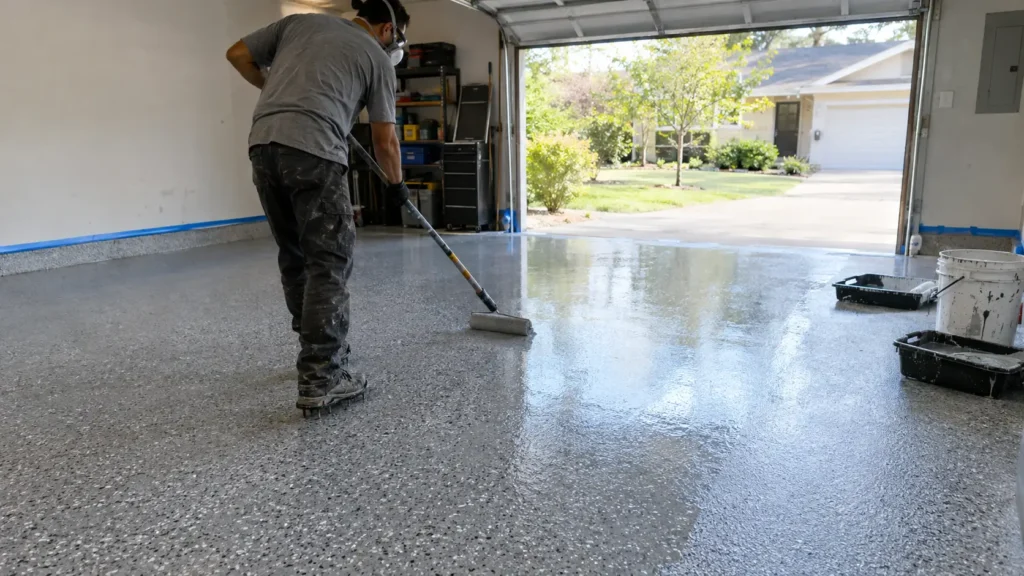
A polyaspartic floor coating is a fast-curing, UV-stable type of aliphatic polyurea, most often used as the clear topcoat on a garage flake floor. A crew can usually take a two-car garage from bare concrete to finished topcoat in one working day. Professionally installed, it typically costs $5 to $10 per square foot, and you can usually walk on it the same day or the next, and park on it after 24 to 48 hours, depending on the product.
In this guide
If you have been getting garage floor quotes lately, you have probably heard “polyaspartic” more than “epoxy”. This guide explains what the coating actually is, what happens on install day, what the manufacturers’ own data sheets say about cure times, and when it is the wrong choice. If you are still deciding between the two coatings, our side-by-side data sheet comparison covers that in detail.
What is a polyaspartic floor coating?
Polyaspartic is a two-part coating. One part is an aliphatic polyisocyanate and the other is a polyaspartic ester. Covestro, the chemical company that supplies many of the raw materials, describes the result as an aliphatic polyurea. According to PCI Magazine, the chemistry was developed in the early 1990s by Covestro, then called Bayer MaterialScience.
Two words in that description matter for your floor:
- Aliphatic means the coating does not yellow in sunlight the way a standard epoxy can. That is why it is the usual choice for the clear top layer in a garage with an open door.
- Polyurea means it is related to the spray coatings used on truck bed liners. Pure polyurea cures in seconds and needs spray equipment. The polyaspartic ester slows that reaction down enough to roll or squeegee by hand.
Chris Mellin, director of technical services at Ultimate Linings, made the same point in AMPP’s Materials Performance magazine in January 2026: polyaspartics behave much like polyurea, but with a slower, more controllable cure.
The layers in a typical garage system
Most “polyaspartic garage floors” are not polyaspartic from top to bottom. They are a system of three or four layers, and the polyaspartic is usually the top one.
Here is what each layer does:
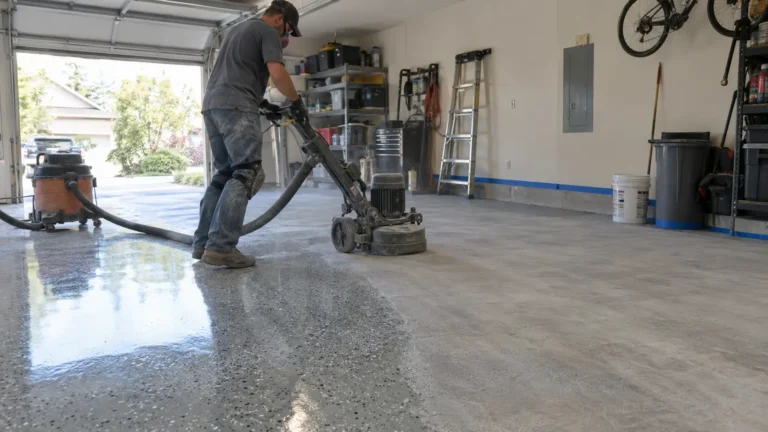
- Grinding. The installer diamond grinds the concrete to remove the weak top layer and open the pores. This is the step that decides whether the coating stays bonded.
- Basecoat. This bonds to the concrete. Installers use an epoxy, a polyurea or a polyaspartic here. Some prefer epoxy because it soaks into the slab more slowly and gives more working time. If you want to understand why epoxy behaves that way, see how two-part resins cure.
- Flake. Colored vinyl chips are thrown into the wet basecoat until it is fully covered. Once the basecoat cures, the loose flake is scraped and vacuumed off.
- Topcoat. One or two coats of clear polyaspartic seal the flake. This layer takes the wear, the hot tires and the UV.
When you compare quotes, ask what the basecoat is. Two quotes can both say “polyaspartic” and describe very different floors.
What install day looks like
The main reason homeowners choose polyaspartic is time. PCI Magazine notes that a typical polyaspartic system can go from basecoat to topcoat in an 8-hour work day. Covestro says its polyaspartic technology cures up to eight times faster than conventional floor coatings.
- MorningGrind and repair cracks
- Late morningBasecoat and flake
- MiddayBasecoat cures, scrape and vacuum loose flake
- AfternoonClear polyaspartic topcoat
- Walk-on2 to 24 hours after the topcoat
- Vehicles24 to 48 hours
“One day” means the crew finishes in one day. It does not always mean you can park that night. The data sheets below show how much that varies.
What the data sheets say about cure times
Every manufacturer publishes a technical data sheet with its working time, walk-on time and the conditions it needs. Here is what six of them say. The numbers are for each manufacturer’s own product, at the temperature it was tested.
| Product (manufacturer) | Working time or pot life | Walk-on | Vehicles | Application conditions |
|---|---|---|---|---|
| RhinoSeal PA (Rhino Linings) | 20 to 30 min | 2 to 4 hours | 24 hours | 40 to 120°F; slab relative humidity no higher than 80% |
| Pro-Aspartic 70 (Proline) | 20 to 25 min gel time at 77°F | 4 to 6 hours | not stated | 40°F and above |
| Polyaspartic Extreme Durability Fast (Polytek) | 30 min | 24 hours (light foot traffic) | 48 hours (light vehicles) | slab moisture vapor emission 3 lbs per 1,000 sq ft per 24 hours or less |
| PACT-8000 (Sika) | about 45 min at 73°F | not stated | not stated | air and slab 50 to 85°F |
| Polyaspartic 85 (Walttools) | 45 min | not stated | not stated | covers 200 to 400 sq ft per gallon |
| MF3590CL (Peintures MF) | 35 to 45 min working time | not stated | not stated | air humidity up to 85%; slab moisture under 4% |
Three things stand out:
- Working time is short. Most products give the installer 20 to 45 minutes once the two parts are mixed. That is why polyaspartic is hard to apply well as a DIY project.
- Drive-on time varies. RhinoSeal PA allows vehicles after 24 hours. Polytek’s Polyaspartic Fast says 48 hours for light vehicles and 24 hours before light foot traffic. Ask your installer which product they use and follow its sheet.
- Temperature and humidity change everything. Most sheets warn that heat and humidity shorten working time and speed up the cure. Rhino Linings tells installers not to mix below the dew point.
What a polyaspartic floor costs
A professionally installed polyaspartic floor typically runs $5 to $10 per square foot. For a full price comparison with epoxy, including garage sizes, see how the two coatings compare on price.
What pushes a quote up or down:
- Slab condition. Cracks, spalling and old coatings add grinding and repair time.
- Basecoat type. A full polyaspartic or polyurea system usually costs more than an epoxy basecoat with a polyaspartic topcoat.
- Topcoat thickness and number of coats. Two topcoats cost more than one but add wear layer.
- Flake coverage. Full broadcast uses more flake than a light scatter.
For a wider look at what a full garage floor coating costs, including epoxy-only systems, see our garage guide.
How long it lasts and what wears it out
The data sheets above do not give a lifespan in years, and you should be wary of anyone who promises one without naming the product and the warranty terms. In practice, how long the floor lasts depends far more on the grinding and the topcoat thickness than on the brand.
The things that wear a polyaspartic floor down are the same as any garage coating:
- Hot tire pickup if the coating was too thin or not fully cured before parking.
- Abrasion from grit dragged in on tires and shoes. A walk-off mat at the door helps.
- Moisture coming up through the slab, which can lift any coating from below.
If an older coating starts to look dull but is still bonded, it can often be refreshed rather than replaced. See our guide to recoating an existing floor.
When polyaspartic is not the right fit
Polyaspartic is a strong choice for most garages, but not all of them.
- A damp slab. Rhino Linings requires a slab humidity test and no more than 80% relative humidity. Basements and slabs without a vapor barrier need testing first. Our guide to moisture checks before coating a basement explains the tests.
- Very hot or humid install days. Short working time gets shorter. A crew that does not adjust can leave roller marks or bubbles.
- DIY. With 20 to 45 minutes of working time, there is little room to fix mistakes. If you are weighing doing it yourself, read our DIY vs pro breakdown first.
- Metallic designs. Installers often use an epoxy base for metallic effects because it gives more time to move the pigment, then add a polyaspartic topcoat for UV protection.
Questions to ask a polyaspartic installer
- Which product do you use for the basecoat and the topcoat? Can I see the data sheets?
- How thick will the topcoat be, in mils, and how many coats?
- What solids percentage is the topcoat?
- How will you grind the floor, and how do you handle cracks?
- Will you test the slab for moisture first?
- When can I walk on it, and when can I park on it?
- What does the warranty cover, and what does it exclude?
Find polyaspartic installers near you
Polyaspartic systems are offered by many garage coating contractors. To find ones near you, you can search by ZIP code or browse contractors by state. We also have city pages for areas such as Las Vegas and Orlando. Ask each one the questions above and compare the answers, not just the price.
Frequently Asked Questions
Is polyaspartic better than epoxy for a garage floor?
For the top layer, it usually is: it is UV-stable and cures in hours. Many installers still use epoxy underneath as the basecoat. Our polyaspartic vs epoxy comparison goes through the data sheets.
How soon can I park on a polyaspartic floor?
It depends on the product. RhinoSeal PA’s data sheet allows vehicles after 24 hours, while Polytek’s Polyaspartic Fast says 48 hours for light vehicles. Ask your installer which product they use.
Can I apply polyaspartic myself?
Kits exist, but most products give you only 20 to 45 minutes of working time after mixing, and the floor still needs diamond grinding. Most homeowners hire a pro for this one.
Can polyaspartic go over an old epoxy floor?
Often yes, if the old coating is still firmly bonded and is sanded first. Our guide to recoating a garage floor explains the tests to run first.


Ready for a floor that lasts?
Compare local epoxy flooring contractors and contact the ones that fit your project. No obligation, no call centers.
Find Contractors Near Me