
Metallic Epoxy Floor Cost: 2026 Prices for Garages, Basements and Homes
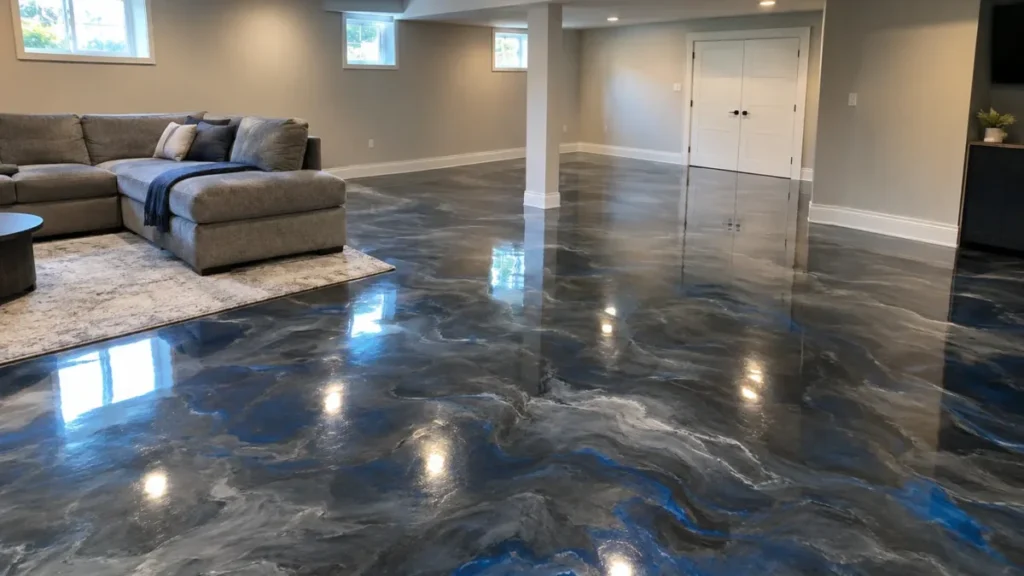
A metallic epoxy floor costs $6 to $12 per square foot installed in 2026. For a typical 2-car garage, that’s about $2,700 to $5,500, roughly double the price of a standard flake system.
In this guide
A metallic epoxy floor costs $6 to $12 per square foot installed in 2026. For a typical 2-car garage, that’s about $2,700 to $5,500, roughly double the price of a standard flake system. Basements and living spaces usually land in the middle of that range, while large commercial showrooms can drop toward the low end per square foot.
Metallic epoxy is the showpiece of floor coatings: pearlescent pigments swirl through the epoxy to create a marbled, almost three-dimensional look, and no two floors come out the same. That artistry is also why price and installer skill vary so much. This guide covers what you’ll pay, what drives the cost, and how metallic compares to other options.
Metallic Epoxy Floor Cost by Space
| Space | Typical size | Installed cost |
|---|---|---|
| 1-car garage | 250 sq ft | $1,600 to $3,200 |
| 2-car garage | 450 to 550 sq ft | $2,700 to $5,500 |
| 3-car garage | 700 to 900 sq ft | $4,500 to $9,000 |
| Basement | 600 to 1,200 sq ft | $4,000 to $11,000 |
| Kitchen or living room | 200 to 500 sq ft | $1,600 to $5,000 |
| Commercial showroom | 2,000+ sq ft | $6 to $10 per sq ft |
Small rooms cost more per square foot because setup, grinding, and the artistic pour take nearly as long on a small floor as on a larger one. For a broader look at every coating system, see our main guide to epoxy flooring costs.
What Is a Metallic Epoxy Floor?
A metallic epoxy floor is a 100% solids epoxy coating mixed with fine metallic or pearlescent pigments. While the coating is still wet, the installer moves the pigments with rollers, brushes, trowels, or solvent sprays to create flowing, marbled patterns. Once a clear top coat goes on, the result looks like polished stone, flowing lava, or rippling water.
What Drives Metallic Epoxy Floor Prices
- Design complexity. A single-color metallic with gentle movement costs least. Multi-color blends, defined “veining,” lava or 3D effects take more time and skill.
- Number of pigments. Each extra color adds material and mixing time.
- Floor prep and condition. Diamond grinding is mandatory. Cracks, old coatings, or uneven slabs add $1 to $3 per square foot.
- Moisture. Metallic coatings show every bubble and blemish, so moisture mitigation (often $0.75 to $2 per square foot) matters even more than with flake.
- Top coat. A urethane or polyaspartic top coat improves scratch and UV resistance and is strongly recommended, adding about $1 to $2 per square foot.
- Installer skill. This is the biggest variable. Experienced metallic artists charge more, and they’re worth it, because a botched metallic floor is expensive to fix.
Metallic Epoxy vs Flake: Which Should You Choose?
| Metallic epoxy | Full-flake epoxy | |
|---|---|---|
| 2-car garage cost | $2,700 to $5,500 | $1,500 to $3,500 |
| Look | Glossy, marbled, one of a kind | Speckled, terrazzo-like |
| Hides dirt and scratches | Poorly | Very well |
| Slip resistance | Lower unless grit is added | Good texture |
| Repairs | Hard to blend | Easy to patch |
| Best for | Basements, showrooms, living spaces | Working garages, shops |
Choose metallic if the space is a showpiece: a finished basement, home gym, man cave, showroom, or a garage that’s more display than workshop. Choose flake for a daily-use garage where tire marks, dust, and dropped tools are part of life. For garage-specific pricing by system and size, see our epoxy garage floor cost guide.
Pros and Cons of Metallic Epoxy
Pros
- ✨Striking, custom look that no other coating matches✓
- 🧹Seamless and easy to clean✓
- 🛡Durable and chemical resistant with a good top coat✓
- 🏗Works over existing concrete, no tear-out needed✓
Cons
- 🔍Shows scratches, dust, and footprints more than flake
- ⚠Can be slippery unless an anti-slip additive is used
- 🔧Hard to repair invisibly
- 🎨Results depend heavily on the installer’s skill
Many of these trade-offs apply to epoxy in general; our article on epoxy flooring pros and cons goes deeper.
Can You DIY a Metallic Epoxy Floor?
Metallic epoxy kits cost about $400 to $1,200 for a 2-car garage, plus grinder rental. But metallic is the hardest coating to DIY: you’re working against a short pot life while manipulating pigments, and mistakes are permanent and highly visible. If you’re weighing the options, our guide to DIY vs professional epoxy shows the real long-term cost.
How Long Does a Metallic Epoxy Floor Last?
A professionally installed metallic floor with a quality top coat lasts 10 to 20 years in a home. In garages, expect to refresh the top coat every 5 to 8 years to keep the gloss and hide fine scratches. Commercial showrooms with heavy foot traffic may need a fresh top coat sooner.
How to Hire a Metallic Epoxy Installer
- Ask for a portfolio of metallic floors specifically, ideally photos of finished jobs, not just samples.
- Ask to see a color sample board in the exact pigments you’re considering.
- Confirm moisture testing and diamond grinding are included.
- Ask which top coat they use and whether anti-slip grit is included.
- Get the warranty in writing, including what happens if the finish shows defects.
- Compare at least three quotes. You can find local installers on our epoxy contractors by state page.
Metallic Epoxy Floor Cost FAQ
How much does a metallic epoxy floor cost per square foot?
Typically $6 to $12 per square foot installed, depending on design complexity, prep, and location.
How much is a metallic epoxy garage floor?
About $2,700 to $5,500 for a standard 2-car garage, and $4,500 to $9,000 for a 3-car garage.
Is metallic epoxy more expensive than flake?
Yes, usually 50 to 100% more, because it takes more material, time, and artistic skill.
Is metallic epoxy slippery?
It can be when wet. Ask for an anti-slip additive in the top coat, especially in garages and kitchens.
Does metallic epoxy scratch easily?
It shows scratches more than flake. A urethane or polyaspartic top coat helps, and the top coat can be refreshed later.
Can metallic epoxy go over tile or wood?
It’s best over concrete. Over tile or wood, the substrate usually needs extra preparation or a different system, so ask an installer first.
Want a one-of-a-kind floor?
Compare local installers with metallic epoxy experience, check their past work, and contact the ones that fit your project.
Find Metallic Epoxy Installers