
Two-Part Epoxy System: How Resin and Hardener Work on Concrete Floors
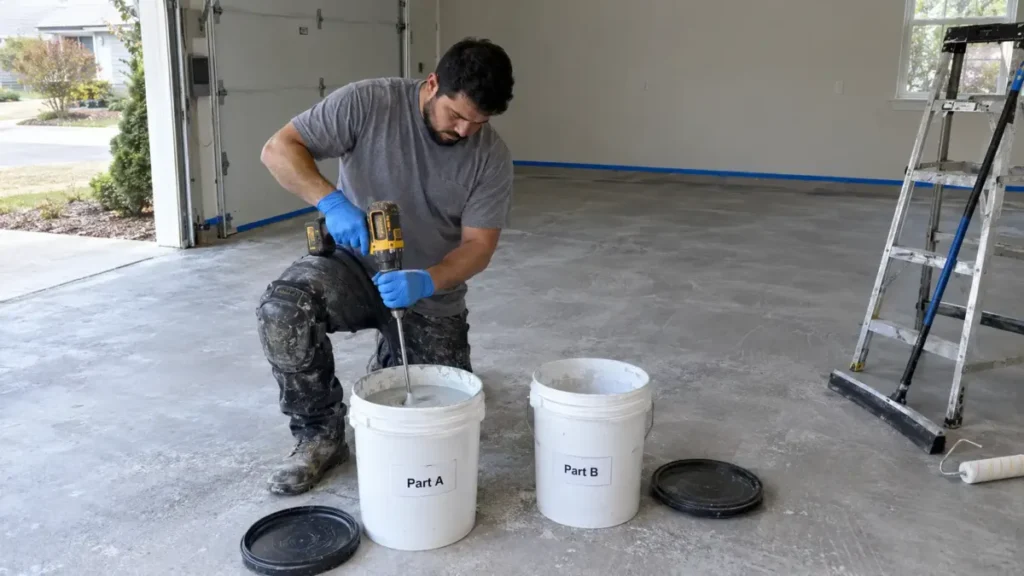
A two part epoxy system is a floor coating sold as resin plus hardener. Once mixed, the two react chemically and cure into a hard, crosslinked layer. Common mix ratios are 2:1 or 1:1 for 100% solids epoxy and 3:1 for water-based kits. Mixed epoxy usually gives you 30 to 50 minutes of working time for 100% solids products and 1 to 2 hours for water-based kits, at about 70 to 80°F. Most floors take foot traffic after about 16 to 30 hours, and cars after 3 to 10 days, depending on the product and temperature.
In this guide
Walk down the floor coating aisle and almost every can says “epoxy.” Only some of them are. A real two part epoxy system (often sold as a 2 part epoxy floor coating) comes as two separate containers, a resin (Part A) and a hardener (Part B), that do nothing on their own and turn into a hard plastic only after you mix them. That reaction is the reason a professional epoxy floor can carry cars for years while a can of “1-part epoxy” paint needs touch-ups.
This guide explains how the two parts work together, what the mix ratio, pot life and recoat window on a data sheet really mean, and how the three main types of two-part floor epoxy compare. Every number below comes from published manufacturer technical data sheets, which are listed at the end.
What Is a Two Part Epoxy System?
A two part epoxy system is a coating packaged as two separate components that must be combined right before use.
- Part A (resin): the epoxy resin itself, often with the color pigment already mixed in. It is usually the larger container.
- Part B (hardener, also called the activator or curing agent): an amine-based chemical that starts the cure. It is usually the smaller container.
Kept apart, both parts stay liquid in their cans for a long time. Rust-Oleum lists a 5-year shelf life for its EpoxyShield kit, and ArmorPoxy lists 12 months for its 100% solids coating. Mixed together, the clock starts. The blend thickens, warms up and hardens on its own, with no air or evaporation needed. That is why manufacturers sell these as full kits, with the two parts measured to the correct ratio in advance.
Pro installers use two-part epoxy as the primer, the body coat that holds decorative flakes or metallic pigments, and sometimes the topcoat. If you have seen a flake garage floor or a glossy metallic epoxy floor, you have seen a multi-layer two-part system.
How Resin and Hardener React
When Part A and Part B meet, the hardener molecules link the resin molecules into a tight three-dimensional network. Chemists call this crosslinking. The result is no longer a liquid that dries; it is a new solid that cannot be redissolved by water or most household chemicals. Three practical things follow from that:
- The mix ratio is fixed. Each hardener molecule is meant to pair with a set amount of resin. Too much or too little of either part leaves unreacted material, which can stay soft or tacky. One manufacturer’s data sheet warns that an incorrect ratio can lead to an unsatisfactory cure time or a mix that never cures at all.
- The reaction makes heat. Curing epoxy warms itself. In a full bucket that heat has nowhere to go, so the mix speeds up and can set in the pail. Spread thin on the floor, the same material stays workable longer. That is why data sheets quote pot life for a specific batch size, such as 1.5 gallons.
- Temperature controls speed. Warm air and a warm slab speed up the cure; cold slows it down. ArmorPoxy, for example, limits its 100% solids coating to substrate temperatures of 50 to 86°F.
Part B: Hardener
2 Part Epoxy Floor Coating Mix Ratios
There is no single “epoxy ratio.” Each product is formulated for its own, and it is printed on the kit and the technical data sheet. These are real examples from published data sheets:
| Product (type) | Mix ratio, A to B by volume | Pot life |
|---|---|---|
| ArmorPoxy ARM707X-CM (100% solids epoxy) | 2 : 1 | 40 to 50 min at 77°F |
| Benjamin Moore HP4300 (100% solids epoxy) | 2 : 1 (ready-mix colors) | 30 min at 77°F |
| ArmorPoxy ARM144X primer (solvent-based epoxy) | 1 : 1 | 3 to 5 hours (2 gal batch) |
| Rust-Oleum EpoxyShield (water-based epoxy) | 3 : 1 base to activator | 1 to 2 hours, by temperature |
Two rules matter more than the numbers themselves:
- Mix full kits. Benjamin Moore tells users of its HP4300 kits not to mix partial kits, because the cans are premeasured. Splitting a kit by eye is the fastest way to get the ratio wrong.
- Mix each part first, then together. Data sheets commonly call for stirring Part A and Part B separately for 2 to 3 minutes, then mixing them together with a slow drill, scraping the sides and bottom so no unmixed material goes on the floor.
Pot Life, Recoat Window and Cure Time
These three terms show up on every two-part epoxy data sheet, and mixing them up causes most DIY failures.
- Pot life is how long the mixed batch stays usable in the bucket. Once it starts to thicken, it will not level or bond properly, even if it still looks wet.
- Recoat window is the period when the next coat can go on and bond chemically to the one below. Miss it and the surface usually needs sanding before the next coat. For floors that are long past that window, see our guide to recoating an epoxy garage floor.
- Cure schedule is when the floor can take foot traffic, light use and full use.
Temperature moves all three. Rust-Oleum’s EpoxyShield sheet is a clear example: the mixed kit lasts 2 hours at 60 to 70°F, 1.5 hours at 71 to 80°F, and only 1 hour at 81 to 85°F. The recoat window for a 100% solids epoxy shifts the same way, as the chart below shows. ArmorPoxy’s data sheet puts that window at 30 to 72 hours at 50°F, 24 to 48 hours at 68°F and 16 to 24 hours at 90°F.
Cure times differ just as much between product types:
| Stage | 100% solids epoxy (ArmorPoxy ARM707X-CM) | Water-based epoxy (Rust-Oleum EpoxyShield) |
|---|---|---|
| Foot traffic | 16 to 30 hours | 24 hours |
| Light use / vehicles | Light traffic 2 to 5 days | Vehicles after 3 days |
| Full cure | 5 to 10 days | Not listed |
All of these figures assume roughly 70 to 77°F and 50% humidity. In a cold garage or basement, plan for longer.
100% Solids vs Water-Based vs Solvent-Based Epoxy
All three are true two-part systems. The difference is what else is in the can besides resin and hardener, and that decides how thick each coat ends up.
| Type | Solids by volume | Film per coat | Typical use |
|---|---|---|---|
| 100% solids | About 99 to 100% | 6 to 12 mils (ArmorPoxy) | Pro garage, basement and commercial floors |
| Water-based | 52.6 to 52.8% (EpoxyShield) | 3.0 to 3.5 mils dry (EpoxyShield) | DIY garage kits |
| Solvent-based | Varies by product | Varies by product | Primers and thin sealer coats |
100% solids epoxy has no water or solvent to evaporate, so almost everything you roll on stays on the floor. That gives a thick, hard film in one coat, and low odor: the ArmorPoxy coating lists a VOC content of 88 g/L. The trade-off is a short pot life and a fast, unforgiving application, which is why most pros pour it in ribbons and spread it with a squeegee and roller. Many installers then finish that thick epoxy base with a faster-curing, UV-stable topcoat, a trade-off our epoxy vs polyaspartic comparison covers.
Water-based epoxy is thinned with water, so about half of what goes on evaporates. The coat is thinner, but it is easier to roll, cleans up with water and gives more working time. It is what most big-box DIY kits use.
Solvent-based epoxy uses solvents to lower the thickness so it soaks into concrete. It shows up mostly as primers and as thin sealer coats. The solvent smell means good ventilation is a must.
Two Part Epoxy vs One Part “Epoxy” Paint
A “1-part epoxy” floor paint is not a two-part system with the mixing done for you. It is a single-component paint that dries as its water evaporates. Behr’s own data sheet lists the resin type of its 1-Part Epoxy floor paint as epoxy/acrylic, meaning an acrylic paint with some epoxy added for toughness.
| Two-part epoxy | One-part epoxy paint | |
|---|---|---|
| How it hardens | Chemical reaction between resin and hardener | Water evaporates, film dries |
| Mixing | Required, at a fixed ratio | Stir and use |
| Working time | Limited by pot life | No pot life; reseal the can |
| Car traffic | 3 days (EpoxyShield) | 7 days (Behr 1-Part) |
| Upkeep | Long-lasting when prep is right | Behr notes yearly touch-ups may be needed where tires roll |
One-part paint is a fair choice for a lightly used basement or a porch where the goal is a clean color. For a garage that sees hot tires, salt and oil, a real two-part system is the better investment. Our pros and cons of epoxy flooring post covers where epoxy shines and where it struggles.
Common Two Part Epoxy Mistakes
Most failed epoxy floors trace back to a handful of avoidable errors:
- Guessing the ratio. Splitting a kit or eyeballing amounts leaves soft or sticky patches that never fully harden.
- Mixing too fast or too little. A fast drill whips in air bubbles. Too little mixing leaves streaks of unreacted resin, often scraped off the bucket wall onto the floor at the end.
- Leaving mixed epoxy in the bucket. Heat builds up in the pail and shortens pot life. Pour it out promptly; ArmorPoxy’s directions call for pouring mixed 100% solids epoxy onto the floor in ribbons right away.
- Coating damp concrete. Several data sheets require slab moisture under 4% and suggest a simple test: tape a 4 x 4 ft plastic sheet to the floor, and if the concrete under it is still dry later, it is ready. Moisture from below is the top cause of peeling in basements, which our basement coating cost guide explains in detail.
- Ignoring amine blush. In cool, humid conditions, a waxy, whitish film can form on curing epoxy. Data sheets warn to check for it before recoating, since the next coat will not bond well over it.
- Skipping surface prep. Epoxy needs open, roughened concrete. Smooth, sealed or oily slabs must be ground or etched first, and any sealer removed.
DIY Kit or Professional Install?
The chemistry is the same either way. What changes is film thickness, prep and the number of coats.
- A DIY water-based kit covers about 250 sq ft per kit in one thin coat, according to Rust-Oleum’s EpoxyShield data. So a 500 sq ft garage needs two kits, and the prep is usually acid etching rather than grinding.
- A professional system normally uses 100% solids epoxy over a diamond-ground slab. At 100 to 200 sq ft per gallon (ArmorPoxy’s figure for 6 to 12 mils), a single body coat already lays down two to four times the film of a DIY coat, and pros usually add a primer, flakes and a clear topcoat on top. If you are deciding what that clear topcoat should be, our guide to choosing between polyaspartic and epoxy compares how fast each cures and how each handles sunlight.
We compare both routes side by side, including cost and lifespan, in DIY epoxy garage floor vs hiring a pro. For installed prices, see what garage floor epoxy usually costs or the broader epoxy flooring price guide. Larger shop and warehouse floors are covered in our commercial epoxy pricing breakdown.
If you would rather have it done right the first time, find epoxy flooring contractors in your state and ask each one which product they use, its mix type and how many coats they apply.
Frequently Asked Questions
What does a two part epoxy system mean?
It means the coating comes as two components, a resin (Part A) and a hardener (Part B). They stay liquid apart and cure into a hard, chemical-resistant layer only after they are mixed at the ratio set by the manufacturer.
What is the mix ratio for two part epoxy floor coating?
It depends on the product. Many 100% solids floor epoxies mix 2 parts resin to 1 part hardener by volume, some primers mix 1:1, and Rust-Oleum’s water-based EpoxyShield mixes 3:1. Always use the ratio on your kit’s data sheet.
How long do you have to apply two part epoxy after mixing?
That is the pot life. Published examples range from about 30 to 50 minutes for 100% solids epoxy at 77°F to 1 to 2 hours for a water-based kit, and warmer temperatures shorten it.
How long does two part epoxy take to cure on a floor?
Most floors take foot traffic after about 16 to 30 hours. Rust-Oleum lists vehicle traffic after 3 days for EpoxyShield, and ArmorPoxy lists a full cure of 5 to 10 days for its 100% solids coating at 77°F.
Is two part epoxy better than one part epoxy paint?
For garages, usually yes. Two-part epoxy cures by chemical reaction into a harder film, while one-part epoxy paint is an acrylic-based paint that dries by evaporation. Behr allows 7 days before cars on its 1-Part Epoxy and notes yearly touch-ups may be needed in tire paths.
What happens if you mix epoxy at the wrong ratio?
The resin and hardener cannot fully react, so the coating may cure slowly, stay soft or tacky, or never cure at all. The only real fix is to remove the bad coating and recoat.
Is 2 part epoxy good for concrete floors?
Yes, when the slab is clean, dry and properly prepared. A 2 part epoxy bonds chemically to roughened concrete and cures harder than one-part epoxy paint, which is why most professional garage and basement floors use it.
Ready for a floor that lasts?
Compare local epoxy flooring contractors and contact the ones that fit your project. No obligation, no call centers.
Find Contractors Near Me