
Is Epoxy Good for a Basement Floor? What to Check Before You Coat
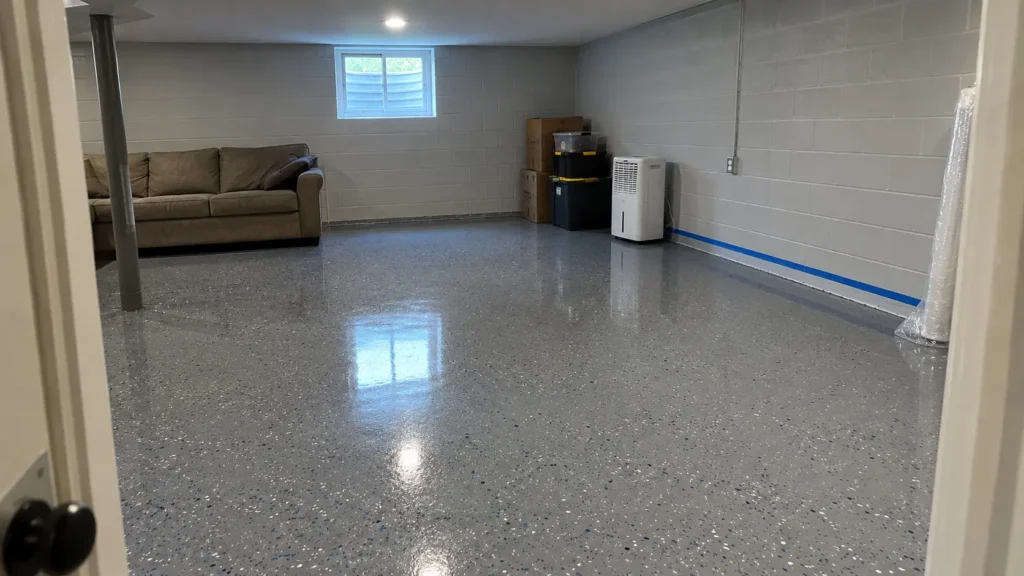
Epoxy is a good basement floor when the slab is dry, warm enough and not under water pressure from below. Many coating data sheets require in-slab relative humidity below 75% (ASTM F2170) or a moisture emission rate under 3 lbs per 1,000 sq ft per day (ASTM F1869). Slabs above those limits need a moisture-control primer first, and basements with active leaks need the water problem fixed before any floor goes down.
In this guide
A bare concrete basement floor is cold, dusty and hard to keep clean, so epoxy looks like an easy upgrade. It can be a very good one. But basements are the one place in a house where epoxy fails most often, and almost always for the same reason: moisture coming up through the slab. Whether epoxy is good for your basement depends far more on your concrete than on the coating.
Why Basements Are Harder Than Garages
A basement slab sits in the ground, so moisture from the soil can move up through the concrete as vapor. When that vapor reaches a sealed coating, it can build up underneath and push the coating off. Basements also tend to be cool and humid, and a cold slab can collect condensation like a cold glass of water in summer.
That is why RIO Flooring tells installers not to coat unless the floor temperature is more than 5°F above the dew point, and why many data sheets set a minimum floor temperature. RIO’s EWP primer, for example, calls for floor and material temperatures between 65 and 90°F and air humidity below 80%.
The Pros of an Epoxy Basement Floor
- Seamless and easy to clean. No grout lines or seams for dust and spills to collect in.
- Handles water on the surface. A spilled drink or a wet boot will not soak into it the way it would into carpet or wood.
- Brighter room. A light-colored coating reflects more light than bare gray concrete.
- Flexible looks. Solid colors, flake blends and metallic finishes are all possible.
- Reasonable cost. Our basement floor coating cost guide puts installed epoxy at roughly $4 to $10 per square foot.
The Cons
- Moisture sensitivity. On a damp slab, epoxy can blister and peel. This is the big one.
- Cold and hard underfoot. Epoxy does not add warmth or cushioning. Area rugs help in living spaces.
- Slippery when wet. A glossy finish can be slick; ask for an anti-slip additive or a flake broadcast.
- Prep is not optional. The slab must be properly ground or prepared, which adds cost.
- It will not fix a leak. A coating is not waterproofing for cracks or walls that let water in.
For a fuller list, see our epoxy flooring pros and cons.
How to Test a Basement Slab for Moisture
- Plastic sheet test (quick check). Tape an 18 x 18 inch plastic sheet tightly to the floor, as Sika’s garage kit instructions describe. Condensation underneath means moisture is coming through. This test can show a problem, but a dry result does not prove the slab is fine.
- Calcium chloride test, ASTM F1869. Measures how much vapor the slab gives off. Many epoxy data sheets want a result under 3 lbs per 1,000 sq ft in 24 hours.
- In-slab relative humidity test, ASTM F2170. Probes placed inside the concrete measure its humidity. Many data sheets want a reading below 75%.
The last two are usually done by a contractor or testing company. New York State’s construction spec notes that 3 lbs and 75% are the limits generally accepted by the flooring industry, and that moisture-control systems are made for slabs with much higher readings, up to 25 lbs.
When Epoxy Is the Wrong Choice
Skip epoxy, at least for now, if your basement has water seeping through cracks or along the walls, puddles after heavy rain, or signs of water pushing up from below. One coating maker’s data sheet warns that applying its coating without a moisture barrier puts it at risk of detachment from hydrostatic pressure. Those problems need drainage or waterproofing work first. Once they are solved and the slab tests dry, a coating becomes a good option again.
It is also worth knowing that epoxy is not unusually fussy. Vinyl plank and other glued floors have similar moisture limits, so a wet slab is a problem for almost any basement floor.
Epoxy or Polyaspartic in a Basement?
Both are two-part coatings and both need a dry slab. The difference is mostly in cure speed and working time. If you are comparing them, our epoxy vs polyaspartic guide lays out the price and performance differences, and our explainer on two-part epoxy systems covers mixing, pot life and cure times.
DIY or Hire a Pro?
The coating itself is the easy part. The hard parts in a basement are testing the slab properly and grinding the concrete, which takes rented equipment and dust control. If you are unsure, start with a professional moisture test even if you plan to do the coating yourself. When you are ready to compare quotes, you can browse basement and garage floor coating pros by state.
Frequently Asked Questions
Is epoxy good for basement floors?
Yes, when the slab is dry, warm enough and free of water pressure from below. On a damp slab, standard epoxy can blister and peel, so test the concrete for moisture before choosing it.
Will epoxy stop moisture coming through a basement floor?
A standard epoxy coating will not. Moisture-control primers are made to reduce vapor coming through a damp slab, but no coating fixes active leaks or water pushing up from below. Those need drainage or waterproofing work first.
How do I test my basement floor for moisture?
A plastic sheet taped to the floor gives a quick first check: condensation underneath means moisture is coming through. For a real answer, use a calcium chloride test (ASTM F1869) or in-slab humidity probes (ASTM F2170). Many epoxy data sheets want under 3 lbs or below 75% relative humidity.
Is an epoxy basement floor cold or slippery?
Epoxy does not add warmth, so it feels like the concrete beneath it. A glossy finish can be slick when wet, which is why many basement floors use an anti-slip additive or a flake broadcast.
Can I put epoxy on my basement floor myself?
You can, but the prep is the hard part. The slab needs proper moisture testing and usually grinding before any coating goes down. Many homeowners get a professional moisture test even when they plan to coat the floor themselves.
Sources
- RIO Flooring, RIO-COAT EWP technical data sheet (below 75% in-slab RH, floor 65 to 90°F, air humidity below 80%, floor 5°F above dew point)
- New York State OGS, Section 090561.13 Moisture Vapor Emission Control (3 lbs and 75% generally accepted limits; moisture-control systems up to 25 lbs)
- CTM Coatings UCTR 4950 data sheet on Knowde (calcium chloride under 3 lbs or RH below 75%; detachment risk from hydrostatic pressure without a moisture barrier)
- Sika Canada, Sikafloor-200 Garage Epoxy Kit installation guide (plastic sheet moisture test)
- Flooring Clarity, moisture limits for vinyl flooring (vinyl moisture limits for comparison)

Ready for a floor that lasts?
Compare local epoxy flooring contractors and contact the ones that fit your project. No obligation, no call centers.
Find Contractors Near Me